
Second Hand Plastic Injection Moulding Machine - Why It is Smart Choice For Indian Manufacturers
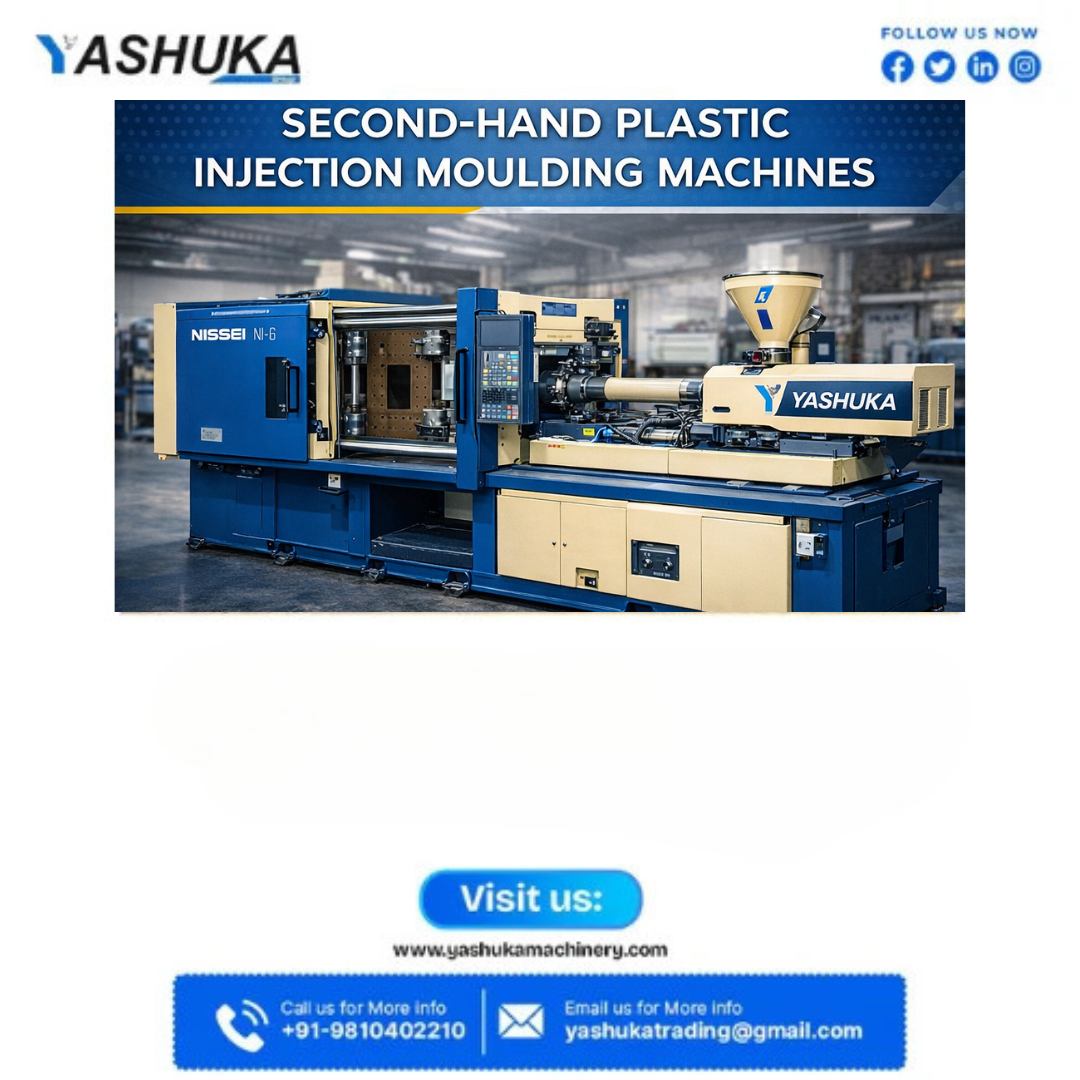
Second Hand Plastic Injection Moulding Machine - Why It is Smart Choice For Indian Manufacturers
Best Second Hand Plastic Injection Moulding Machine: Why It is Smart Choice For Indian Manufacturers - Complete Detail Guide
Second hand plastic injection moulding machines are a smart, cost-effective solution for Indian manufacturers looking to scale production without heavy capital investment. These refurbished machines deliver the same output quality as new ones — at 35% to 65% lower cost — making them ideal for SMEs, startups, and growing businesses across India. From packaging and automotive to agriculture and medical devices, used injection moulding machines serve virtually every manufacturing sector. Buyers get access to premium international brands from Germany, Japan, Taiwan, and Austria at accessible prices. The key to a successful purchase lies in choosing a trusted, experienced supplier. Since 2012, Yashuka Machinery — part of Topall Impex — has been India's reliable name in refurbished injection moulding machines and auxiliary equipment. Based in Delhi, they supply thoroughly inspected, tested, and performance-ready machines pan-India. Contact Yashuka Machinery today to find the right machine for your production needs at the best price.
What is a plastic injection moulding machine ?
A plastic injection moulding machine is an industrial equipment that melts raw plastic material and injects it under high pressure into a custom-designed mould cavity. Once the molten plastic cools and solidifies inside the mould, it takes the exact shape of the product you want to manufacture — be it a bottle cap, a dashboard part, a toy, or a medical component. The machine works on a straightforward three-stage principle: melt, inject, and eject. The entire cycle can repeat hundreds of times per hour, making it one of the most efficient manufacturing systems available for plastic product production. These machines range from small bench-top units for lightweight parts to massive hydraulic systems that produce automotive components. They are the backbone of plastic manufacturing across almost every industry in the world.
Why Buy a Second Hand Machine? Why Second Hand Machine in Demand
The demand for second hand plastic injection moulding machines in India has grown significantly over the past decade. Here is the real reason why:
New injection moulding machines from top brands cost anywhere between ₹15 lakh to ₹1.5 crore or more depending on tonnage, brand, and features. For a small or medium enterprise (SME), that capital investment is often impossible to justify in the early years. A well-refurbished second hand machine, on the other hand, gives you the same mechanical performance at 40% to 60% lower cost. Indian manufacturers — especially those in packaging, automotive, agriculture, and household goods — have figured out that a properly restored machine delivers the same output quality without the premium price tag. Beyond cost, there is also the issue of availability. Imported machines and premium domestic models often have long delivery timelines. A refurbished machine from a trusted dealer like Yashuka Machinery is available for immediate dispatch, which means you start producing faster.
Additionally, India's growing emphasis on circular economy and sustainable manufacturing has pushed businesses toward refurbished industrial equipment. Buying a used machine reduces manufacturing waste, extends the product lifecycle, and lowers your carbon footprint — something that matters more than ever in today's business environment.
Benefits of Using Second Hand Plastic Injection Moulding Machine
Using a second hand plastic injection moulding machine is not just about saving money. It brings a full package of operational and business advantages. You immediately lower your capital expenditure. Since the machine is already depreciated, your book value stays lean and your ROI timeline shortens dramatically. You get access to proven technology. Many second hand machines available in the market come from reputed European, Japanese, or Taiwanese manufacturers. These are machines built to last 20 to 30 years. Buying them second hand means you are getting premium engineering without the premium price. Your production ramp-up becomes faster. Instead of waiting months for a new machine to be manufactured and delivered, a refurbished machine is ready for installation within days or weeks. You also get more flexibility in machine selection. The second hand market offers a wider variety of tonnage, clamping force, and injection volumes than what new machine dealers typically stock for SME buyers. Maintenance costs on a properly refurbished machine are often predictable and low, especially when you buy from a reliable dealer who has replaced all worn parts before sale.
Uses of Second Hand Plastic Injection Moulding Machine
Second hand plastic injection moulding machines are used across an incredibly wide range of production applications in India. They manufacture everyday consumer plastic items like storage containers, buckets, cups, and kitchen accessories. They produce industrial parts like gears, connectors, housings, and brackets. In the automotive sector, they create dashboards, bumpers, door handles, and under-the-hood components. In agriculture, these machines produce drip irrigation components, spray nozzles, and fertilizer container parts. Medical device manufacturers use smaller tonnage refurbished machines to produce syringes, sample collection vials, and disposable medical components. Electronics companies use them for switches, casings, and connector bodies. The construction sector uses them for PVC fittings, pipe ends, and cable ducts. Essentially, if you can design it in plastic and mould it, a second hand injection moulding machine can produce it at volume.
Types of Second Hand Plastic Injection Moulding Machine
Not all injection moulding machines are built the same way. When you enter the second hand market, you will encounter several types. Understanding each type helps you buy the right one for your specific production need.
Hydraulic injection moulding machines are the most common type available in the second hand market. They use hydraulic pressure to drive the injection and clamping systems. They are robust, easy to maintain, and ideal for high-tonnage applications. Most Indian buyers prefer these for general-purpose plastic manufacturing.
Electric injection moulding machines use servo-driven motors instead of hydraulic systems. They are more energy-efficient, faster, and more precise than hydraulic machines. Second hand electric machines from brands like Fanuc, Sumitomo, or Arburg are highly sought after in India for precision part manufacturing.
Hybrid injection moulding machines combine hydraulic and electric drive systems. They offer a balance between the power of hydraulic systems and the precision of electric systems. Second hand hybrid machines are ideal for automotive and electronics applications.
Vertical injection moulding machines are used for insert moulding and overmoulding applications. They are compact and ideal for operations where you need to insert metal or fabric components into the mould before injecting plastic.
Two-component or multi-component injection moulding machines allow you to inject two different materials or colours in a single cycle. These are available in the second hand market and are used for toothbrush handles, multi-colour automotive parts, and medical devices.
Key Industries Using Second Hand Plastic Injection Moulding Machine in India
India's manufacturing ecosystem is diverse, and second hand plastic injection moulding machines serve a wide cross-section of industries.
The packaging industry is one of the largest consumers. Caps, closures, containers, and thin-wall food packaging components are all produced on injection moulding machines. Many packaging companies in Delhi NCR, Ahmedabad, and Pune run their operations entirely on refurbished machines.
The automotive industry uses injection moulding for interior and exterior plastic components. Tier 2 and Tier 3 auto component manufacturers across Faridabad, Gurgaon, Chennai, and Pune extensively use second hand machines to keep their production costs competitive.
The agriculture sector, particularly in states like Maharashtra, Punjab, and Gujarat, uses these machines to manufacture drip irrigation parts, sprinkler components, and agri-equipment housings.
The electrical and electronics industry produces switch bodies, junction boxes, connectors, and appliance parts on injection moulding machines. Many contract manufacturers in this sector prefer refurbished machines because they can acquire multiple units within the same budget.
Toys and stationery, household goods, construction hardware, medical disposables, and footwear components are additional sectors where second hand injection moulding machines play a significant role in Indian manufacturing.
Why Second Hand Plastic Injection Moulding Machine is Important
For India's manufacturing ambitions — especially under the Make in India initiative — access to affordable production equipment is critical. Not every manufacturer can afford a ₹50 lakh machine on day one. Second hand machines bridge this gap.
They democratise manufacturing. A first-generation entrepreneur with limited capital can start producing at commercial scale without taking on crippling debt. A mid-size manufacturer can add production capacity without diverting working capital from operations.
Second hand machines also support India's push toward self-reliance in plastic components. Many industries that currently import plastic parts from China can produce them domestically if they have access to the right machinery at the right cost. Refurbished machines make this transition economically viable.
From a sustainability standpoint, extending the operational life of a machine reduces industrial waste and the environmental impact of producing new machinery. This aligns with India's broader commitment to responsible industrial growth.
How does Second Hand Plastic Injection Moulding Machine Work? ( The Process )
Understanding the working process helps you operate the machine correctly and identify any performance issues after purchase.
The process begins with material loading. Raw plastic granules or pellets — typically materials like PP, HDPE, ABS, PVC, nylon, or polycarbonate — are loaded into the hopper at the top of the machine.
These granules move into the barrel, where a rotating screw carries them forward while heating elements melt them into a uniform molten state. The temperature inside the barrel is carefully controlled in multiple zones to ensure consistent melt quality.
Once enough molten plastic has accumulated at the front of the screw, the injection stage begins. The screw moves forward like a plunger, pushing the molten plastic through a nozzle and into the closed mould at high pressure. The mould is held shut by the clamping unit, which applies significant force to prevent the mould from opening under injection pressure.
The molten plastic fills the mould cavity and takes its shape. Cooling channels inside the mould circulate water to solidify the plastic quickly. Once cooled, the clamping unit opens, and ejector pins push the finished part out of the mould.
The machine then closes the mould again, and the entire cycle repeats. Depending on part size and material, a full cycle can take anywhere from a few seconds to several minutes.
Second Hand Plastic Injection Moulding Machine - Key Technical Specifications to Look For
When you evaluate a second hand injection moulding machine, you need to look at its technical specifications carefully. These numbers determine whether the machine is right for your production requirements.
Clamping force is measured in tonnes and represents the force the machine applies to keep the mould shut during injection. Common ranges are 50 tonnes, 100 tonnes, 200 tonnes, 300 tonnes, and upward. Choose clamping force based on your part size and the injection pressure required.
Injection capacity, also called shot weight, tells you the maximum weight of plastic the machine can inject in a single shot. It is typically measured in grams or cubic centimetres. Match this to the weight of your part with some margin.
Screw diameter determines the plasticising capacity of the machine. Larger screws process more material per rotation. The screw and barrel condition in a second hand machine is critical — inspect for wear, corrosion, and scoring.
Platen size and tie-bar spacing determine the maximum mould dimensions you can install. Always check that your existing or planned moulds fit within these dimensions.
Injection pressure is the pressure at which molten plastic enters the mould. Higher injection pressure allows you to fill thin-walled or complex moulds. Verify that the machine's maximum injection pressure matches your product requirements.
Dry cycle time indicates how fast the machine can open, close, and eject without the injection process. A faster dry cycle means more production cycles per hour.
Control system type — whether it is an older relay-based system or a modern PLC with touchscreen — affects ease of operation, precision, and the ability to store production parameters.
Benefits of Refurbished vs. New Machines
This is the question every buyer asks. Here is an honest comparison.
A new machine comes with full manufacturer warranty, the latest technology, higher energy efficiency in modern electric models, and factory-fresh components. But the price is significantly higher, delivery timelines are longer, and depreciation hits immediately.
A refurbished machine from a reputable dealer like Yashuka Machinery gives you a machine that has been disassembled, inspected, repaired, and tested before sale. Critical parts like the screw, barrel, seals, hydraulic hoses, and electrical components are replaced as needed. The machine is proven — you can see its actual performance rather than relying on manufacturer specifications alone.
For a business that is scaling up or entering production for the first time, the financial advantage of a refurbished machine is decisive. You can acquire two or three refurbished machines for the cost of one new machine, effectively tripling your production capacity.
The key difference comes down to the source and quality of refurbishment. A machine refurbished by an experienced team with genuine parts performs reliably for years. A poorly reconditioned machine bought from an unverified source creates problems. This is why sourcing from an experienced, established dealer matters enormously.
Top Exporting Countries & Brands - Where to Buy Second Hand Machines
The global second hand injection moulding machine market is fed by machines from several key manufacturing economies.
Germany produces some of the world's finest injection moulding machines. Brands like Arburg, KraussMaffei, and Engel are globally respected for their engineering quality, longevity, and precision. German second hand machines command a premium but deliver exceptional performance.
Japan is the home of brands like Fanuc, Toshiba, JSW, and Sumitomo. Japanese machines are known for their precision, energy efficiency, and longevity. They are particularly popular for electric and hybrid machine applications.
Taiwan produces cost-effective machines from brands like Chen Hsong, Multiplas, and Victor Taichung. These machines offer solid performance and are well-suited to the Indian market's cost sensitivity.
South Korea contributes brands like LG, Hyundai, and Woojin, which are reliable mid-range machines with good availability of spare parts.
China has become a major supplier of second hand machines, with brands like Haitian, Chen Hsong, and Borch available at competitive prices. Quality varies widely, so inspection is essential.
India itself produces machines from brands like Windsor, Ferromatik Milacron India, L&T Demag, and Electronica, many of which have strong second hand markets domestically.
Key Factors to Check Before Buying Second Hand Machines
Buying a second hand plastic injection moulding machine is a significant investment. These are the factors you must verify before committing.
Check the machine's age and production history. A machine that is 5 to 10 years old with documented maintenance records is a safer bet than a 15-year-old machine with no history. Ask for production logs if available.
Inspect the barrel and screw condition. These are the highest-wear components in any injection moulding machine. Check for scoring on the screw flights, corrosion in the barrel bore, and dimensional wear. A worn screw-barrel combination affects output quality and increases material wastage.
Examine the hydraulic system. Check the hydraulic oil for contamination and colour. Inspect all hoses, fittings, and the hydraulic pump for leaks or wear. Hydraulic issues are among the most expensive to repair after purchase.
Evaluate the clamping unit and platens. Check that the tie bars are straight and undamaged. Verify that the clamping mechanism moves smoothly without unusual noise or resistance. Bent tie bars indicate the machine has been overloaded at some point.
Test the control system. Power up the machine and verify that the controller responds correctly. Check temperature controllers, pressure sensors, and timer functions. Modern PLC systems are easier to diagnose than older relay systems.
Look at the heating bands and thermocouples on the barrel. These are relatively inexpensive to replace but their condition indicates how well the machine has been maintained.
Inspect the mould mounting area for any damage, warping, or misalignment that would affect mould fit and product quality.
Check the cooling system and water connections. Blocked or corroded cooling channels affect cycle time and product quality.
Questions to Ask the Seller
Before finalising your purchase, ask these questions directly to the seller.
Why is the machine being sold? Understanding the reason — whether it is capacity upgrade, business closure, or product change — tells you a lot about the machine's condition.
How many production hours has the machine logged? Higher hours mean more wear, but a well-maintained high-hour machine can outperform a poorly maintained low-hour one.
What maintenance work has been done recently? Ask for records of recent repairs, part replacements, and servicing.
Has the machine ever had major breakdowns? Find out if the machine experienced hydraulic failures, screw damage, or control system failures.
Are the original manuals and electrical drawings available? These are essential for maintenance and troubleshooting. Machines sold without documentation are harder to service.
Does the machine come with moulds, tooling, or auxiliary equipment? Some sellers include these as a package, which can add significant value.
What is the warranty or return policy? Even in the second hand market, a reputable dealer should stand behind the machine they sell.
Can you see the machine running before purchase? A live test run is the single most important step before buying.
Where to Buy Second Hand Plastic Injection Moulding Machine
You have several options when sourcing second hand injection moulding machines in India.
Specialised machinery dealers like Yashuka Machinery are the most reliable source. They inspect, refurbish, and guarantee the machines they sell. They also provide after-sales support, spare parts access, and installation assistance.
Industrial auctions and liquidation sales sometimes offer machines at very low prices, but they come with no guarantees and no refurbishment. You are buying as-is, which carries significant risk for a buyer without deep technical expertise.
Online platforms like IndiaMart and TradeIndia list second hand machines from various sellers. Prices can be competitive, but verification and inspection are entirely your responsibility. Quality varies enormously.
Direct purchase from factories that are upgrading or closing is another route. This can yield good machines at fair prices, but again, independent inspection is critical.
For buyers in Delhi NCR and North India, Yashuka Machinery offers one of the widest selections of refurbished injection moulding machines with full inspection reports, live demonstrations, and after-sales service support.
Common Myths About Second Hand Plastic Injection Moulding Machine
Several misconceptions hold buyers back from making a sound investment. Here is the truth behind the most common ones.
Myth: Second hand machines always break down frequently. Fact: A properly refurbished machine from a reputable dealer has all worn parts replaced before sale. Its reliability is comparable to new equipment when maintained correctly.
Myth: You cannot get spare parts for old machines. Fact: Most major brands have spare part availability for 15 to 20 years. Local machining can replicate mechanical parts. PLC systems can often be retrofitted.
Myth: Second hand machines are inefficient and waste material. Fact: Material wastage depends on screw-barrel condition, process setup, and mould quality — not just machine age. A properly set up second hand machine produces the same quality output as a new one.
Myth: Banks do not finance second hand machinery. Fact: Many NBFCs and public sector banks in India offer machinery loans for refurbished industrial equipment, especially when purchased from registered dealers with proper documentation.
Myth: You cannot achieve tight tolerances with old machines. Fact: Tolerance accuracy depends on mould quality, machine calibration, and process control. A well-maintained second hand machine with a good mould can achieve tight dimensional tolerances consistently.
Common Risks & How to Avoid Them
Buying a second hand machine carries real risks if you approach it without the right knowledge. Here is how to protect your investment.
The biggest risk is buying from an unverified source without inspection. Avoid this by always insisting on a physical inspection or requesting a third-party technical evaluation before purchase.
Buying a machine with a worn screw and barrel is a common mistake. This leads to inconsistent melt quality, increased cycle times, and higher material waste. Always demand a screw-barrel measurement report from the seller.
Overlooking the hydraulic system condition leads to expensive repairs after purchase. Hire a hydraulic technician to assess the system independently if you are not confident doing it yourself.
Ignoring electrical system age is another costly error. Old relay-based electrical systems are difficult to repair when they fail. Consider the cost of a PLC retrofit when evaluating the overall machine price.
Not verifying the seller's reputation is perhaps the most avoidable risk. Always check references, visit the seller's facility, and look for established businesses with a track record. Yashuka Machinery has been operating since 2012 with a verified client base across India.
Safety Tips for Operating a Second Hand Plastic Injection Moulding Machine
Operating any industrial machinery requires strict safety discipline. These tips apply specifically to second hand machines.
Always conduct a full safety inspection before starting a machine that has been idle or newly installed. Check all safety guards, interlocks, and emergency stop functions before the first power-on.
Never bypass safety interlocks. Some operators disable safety switches to speed up operations. This is dangerous and should never be permitted on your shopfloor.
Wear appropriate personal protective equipment including heat-resistant gloves, safety glasses, and steel-toed footwear when working near the machine.
Keep the area around the machine clean and free of plastic waste, hydraulic fluid spills, and water. Slips and falls near hot machinery cause serious injuries.
Train your operators before they run the machine independently. A basic training programme covering startup, normal operation, shutdown, and emergency procedures significantly reduces accident risk.
Monitor barrel temperatures carefully. Overheating can cause material degradation, pressure buildup, and in extreme cases, a molten plastic discharge.
Never open the mould area during an injection cycle. Ensure all guards are in place and the machine has completed its full cycle before accessing the mould.
Maintenance Tips
Good maintenance extends machine life significantly and reduces unplanned downtime. Follow these practices consistently.
Change hydraulic oil on schedule — typically every 2,000 to 4,000 hours of operation or annually, whichever comes first. Check hydraulic oil regularly for discolouration, water contamination, or metallic particles.
Inspect and replace hydraulic hoses that show signs of cracking, abrasion, or weeping. A burst hydraulic hose is both a safety hazard and a production stopper.
Clean barrel and screw regularly by running purging compounds through the system during material changeovers and at the end of each shift. This prevents carbon buildup and material degradation.
Check heating bands weekly for physical damage and verify that they are maintaining correct temperature. Replace any band that cannot hold set temperature.
Lubricate all moving parts — tie bar threads, toggle linkages, ejector mechanisms, and platen guides — according to the manufacturer's schedule.
Inspect moulds separately from the machine. Damaged or worn moulds create flash, dimensional errors, and increased injection pressure that stresses the machine.
Keep the control panel area clean and dry. Electrical faults are a leading cause of unplanned machine downtime.
Schedule a full machine inspection with a qualified technician every six months to catch issues before they become expensive breakdowns.
Do's and Do not with Second Hand Plastic Injection Moulding Machine
Do's
- Do inspect the machine thoroughly before purchase, either personally or through a qualified technician.
- Do ask for a live demonstration run before finalising the purchase.
- Do verify that all safety guards and interlocks are functional before operating the machine.
- Do follow the manufacturer's maintenance schedule from day one.
- Do keep a log of all maintenance, repairs, and part replacements.
- Do train all operators properly before allowing independent machine operation.
- Do keep a stock of critical spare parts — heating bands, seals, and hydraulic fittings — to minimise downtime. Do source machines from reputable, established dealers with after-sales support.
Don'ts
- Do not buy a machine without a physical inspection, no matter how attractive the price appears.
- Do not bypass any safety interlock or guard, even temporarily.
- Do not run the machine above its rated clamping force or injection pressure.
- Do not ignore unusual sounds, vibrations, or temperature deviations — investigate them immediately.
- Do not use incorrect raw materials that are outside the machine's processing temperature range.
- Do not skip hydraulic oil changes or use contaminated oil.
- Do not allow untrained personnel to operate the machine unsupervised.
- Do not purchase from sellers who refuse to provide machine history or documentation.
Pros and Cons Second Hand Plastic Injection Moulding Machine
Every investment has two sides. Here is an honest assessment.
Pros
The advantages are significant. You save 40% to 60% on capital cost compared to buying new. You get faster delivery and installation. You access proven, durable machines from reputed brands at affordable prices. Your break-even point comes much earlier. You can acquire more capacity within the same budget. You contribute to sustainable manufacturing practices.
Cons
The disadvantages are real but manageable. There is no original manufacturer warranty. The machine's history may be incomplete. Technology may be older compared to current new machine offerings. Energy consumption may be higher than modern electric machines. Spare parts for very old models may require sourcing effort. The risk of buying a poorly refurbished machine exists if you do not buy from a verified source.
The key takeaway: the pros significantly outweigh the cons when you buy from a reputable dealer who provides full inspection, refurbishment documentation, and after-sales support.
Things to Check Before Buying an Second Hand Plastic Injection Moulding Machine
Use this checklist before you commit to any purchase.
Verify machine brand, model, and year of manufacture.
Confirm clamping force and injection capacity match your production requirement.
Inspect the screw and barrel for wear and corrosion.
Test hydraulic pressure and check for leaks.
Verify all safety interlocks and guards are functional.
Check the control system for full functionality.
Inspect tie bars and platens for straightness and damage.
Test the cooling water circuit for flow and leaks.
Check heating bands and thermocouples for correct function.
Request production logs and maintenance history.
Witness a live production run. Confirm availability of spare parts for that model.
Verify the seller's credentials and reputation. Confirm documentation — invoice, test certificate, and warranty terms.
Why Indian Manufacturers Trust Second Hand Plastic Injection Moulding Machine
Indian manufacturers have a uniquely practical approach to capital investment. They look for maximum output at minimum input cost — and second hand injection moulding machines deliver exactly that.
The Indian SME landscape is built on resourcefulness. Entrepreneurs who have grown from garage workshops to mid-size factories understand that it is not the equipment's age that matters — it is its condition and how well it is maintained.
India's deep engineering talent pool means that skilled technicians can maintain and repair even older machines efficiently. The availability of local machining services means that mechanical parts can be replicated or repaired without waiting for international spares.
The track record speaks for itself. Thousands of Indian manufacturers across Delhi NCR, Mumbai, Ahmedabad, Pune, Ludhiana, and Chennai have built successful plastic manufacturing businesses on refurbished equipment. The machines run reliably, the products meet quality standards, and the businesses remain profitable because their equipment costs are under control.
Yashuka Machinery has been part of this story since 2012, supplying high-performance refurbished injection moulding machines and auxiliary equipment to manufacturers across India. The trust that Indian manufacturers place in second hand machines comes from direct, measurable results on the shopfloor.
Frequently Asked Question Related To Second Hand Plastic Injection Moulding Machine
Q1. What is a second hand plastic injection moulding machine?
A second hand plastic injection moulding machine is a pre-owned industrial machine that melts plastic granules and injects them into a mould to produce plastic parts. When refurbished properly, it performs just like a new machine at a significantly lower cost.
Q2. Is it safe to buy a second hand plastic injection moulding machine?
Yes, it is completely safe — provided you buy from a trusted and experienced dealer like Yashuka Machinery. Every machine we supply is thoroughly inspected, tested, and refurbished before delivery. All safety guards and interlocks are verified functional before the machine leaves our facility.
Q3. How much does a second hand plastic injection moulding machine cost in India?
The price depends on the machine's tonnage, brand, age, and condition. Generally, refurbished injection moulding machines in India start from ₹1.5 lakh for smaller units and can go up to ₹25 lakh or more for high-tonnage machines from reputed European or Japanese brands. Contact Yashuka Machinery for an accurate quote based on your specific requirement.
Q4. Which brands of second hand injection moulding machines are available at Yashuka Machinery?
Yashuka Machinery supplies refurbished machines from globally trusted brands including Engel, Arburg, KraussMaffei, Windsor, L&T Demag, Ferromatik, Haitian, JSW, and Chen Hsong. Availability depends on current stock. Call us to check the latest inventory.
Q5. What plastic materials can a second hand injection moulding machine process?
Most refurbished injection moulding machines can process a wide range of thermoplastics including PP, HDPE, LDPE, ABS, PVC, Nylon, Polycarbonate, and Acetal. The specific materials a machine can handle depend on its barrel configuration and maximum processing temperature.
Q6. How long does a refurbished plastic injection moulding machine last?
A well-refurbished machine from a reputed brand can deliver reliable performance for an additional 10 to 15 years after purchase — sometimes longer. The key is consistent maintenance, correct operation, and buying a machine that has been properly reconditioned before sale.
Q7. Can I get financing or a loan to purchase a second hand injection moulding machine?
Yes. Several nationalised banks and NBFCs in India offer machinery loans for refurbished industrial equipment when purchased from a registered dealer with proper documentation. Yashuka Machinery provides all necessary paperwork to support your financing application.
Q8. What should I check before buying a second hand plastic injection moulding machine?
Always inspect the screw and barrel condition, hydraulic system health, control panel functionality, tie bar alignment, heating bands, safety interlocks, and cooling circuit. Ask for the machine's maintenance history and insist on a live production trial run before purchase. Yashuka Machinery provides a full inspection report with every machine.
Q9. Does Yashuka Machinery offer installation and after-sales support?
Yes. Yashuka Machinery provides complete after-sales support including machine installation, on-site commissioning, operator training, and ongoing technical assistance. We make sure your machine is production-ready from day one.
Q10. Why should I choose a second hand plastic injection moulding machine over a new one?
A refurbished injection moulding machine gives you 40% to 60% savings on capital cost compared to buying new. You get proven technology from top global brands, faster delivery, and a quicker return on investment. For Indian SMEs and manufacturers looking to scale production without heavy capital expenditure, a quality second hand machine is simply the smarter business decision.
Contact Yashuka Machinery For Second Hand Plastic Injection Moulding Machine At Best Price in Delhi
If you are ready to invest in a second hand plastic injection moulding machine or want expert guidance before making a decision, Yashuka Machinery is your most reliable partner in India.
Since 2012, we have helped hundreds of manufacturers across Delhi NCR and India find the right refurbished injection moulding machine for their specific production needs. Our machines are thoroughly inspected, refurbished with genuine parts, and tested before delivery. We offer transparent pricing, full documentation, installation support, and after-sales service — because we believe that buying a machine is the beginning of a long-term relationship, not just a transaction.
Whether you need a compact 50-tonne machine for small component production or a high-tonnage system for heavy-duty industrial parts, we have the inventory, the expertise, and the commitment to deliver the right solution at the best price.
Do not let high equipment costs hold your manufacturing ambitions back. Get in touch with the Yashuka Machinery team today, and let us help you build a stronger, more profitable production operation with the right refurbished injection moulding machine.
Yashuka Machinery — India's Trusted Name in Refurbished Injection Moulding Machines and Auxiliary Equipment Since 2012.
Reach out to us for pricing, availability, technical consultation, and a live machine demonstration at our Delhi facility.


